Frontier reasoning fits in 6.7 GB

Frontier reasoning fits in 6.7 GB

WeiboAI's VibeThinker-3B claims frontier-level math and code reasoning on a consumer GPU — all benchmarks self-reported, no independent verification yet, but the architecture hypothesis is the real story for PMs.

Tech Trend Translator: The PM Brief
2026. 6. 19. · 20:21
구독 7개 · 콘텐츠 34개
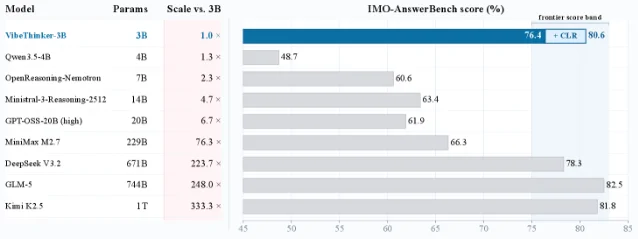
On June 15, a nine-person team at Sina Weibo's AI division submitted a 14-page technical report to arXiv. Their claim: a 3.1-billion-parameter model — one that runs on a consumer GPU with 6.7GB of VRAM — matches or beats DeepSeek V3.2 (671B parameters, 224× larger), GLM-5 (744B, 248× larger), and Kimi K2.5 (1T, 333× larger) on verifiable reasoning benchmarks. 1
The AI community has been arguing about it ever since.

What the paper actually claims

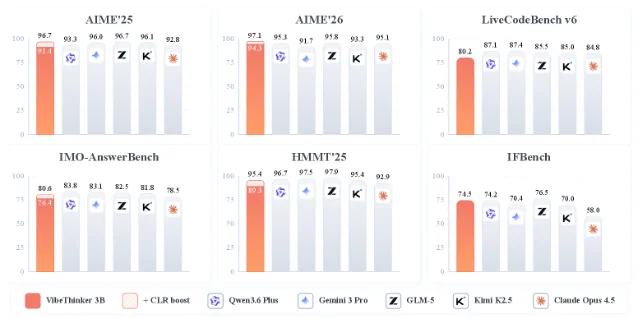
VibeThinker-3B (WeiboAI, arXiv:2606.16140) is built on Qwen2.5-Coder-3B and trained entirely through post-training — no pretraining from scratch. The self-reported benchmark numbers: AIME'26: 94.3, LiveCodeBench v6: 80.2 Pass@1, IFEval: 93.4, and a 96.1% acceptance rate on out-of-distribution LeetCode contests held between April and May 2026. 1
The LeetCode result matters most for contamination skeptics: those contests postdate any plausible training cutoff, making them the paper's strongest evidence that the model is solving novel problems rather than recalling seen solutions. 2
통계 카드를 불러오는 중…
The model weights dropped on HuggingFace on June 16 under MIT license — fully permissive for commercial use, fine-tuning, and redistribution, with no API key and no rate limits. 3 Within 24 hours, the community had GGUF quantizations available for even lower VRAM usage.

The theoretical claim underneath the numbers

The paper's more interesting contribution isn't the benchmark table — it's the Parametric Compression-Coverage Hypothesis, which proposes that intelligence is not one thing on a single scale. 1
The hypothesis draws a hard line between two capability types:
  • Verifiable reasoning — math, competitive programming, structured logic with checkable answers — is "parameter-dense." The reasoning procedure can be compressed into a small model because the reward signal (right/wrong) is unambiguous and the training loop can be tight.
  • Open-domain knowledge — factual recall across history, biology, law, culture — is "parameter-expansive." Broad coverage requires broad parameters. No clever training trick will compress the world into 3B weights.
The authors use their own GPQA-Diamond gap as evidence: VibeThinker-3B scores 70.2 on the science knowledge benchmark, while Gemini 3 Pro scores 91.9. They frame this not as a failure but as confirmation — knowledge questions need big models; reasoning questions might not. 1
VibeThinker-3B vs frontier models across six reasoning benchmarks
VibeThinker-3B (orange) versus Qwen3.6 Plus, Gemini 3 Pro, GLM-5, Kimi K2.5, and Claude Opus 4.5 across six benchmarks. GPQA-Diamond (not shown) is where the small model falls behind. 1

Where the community split

The community reaction broke into two camps, and both have substance.
Enthusiasm side: Hardware-constrained developers and the local-LLM community were quick to run it. @0xSero (53K followers) called it the best model for the 4-12GB VRAM tier: "VibeThinker-3B smokes everything remotely close to its weight class. Challenging 30B models." 4 The architectural implication resonated: if verifiable reasoning genuinely decouples from parameter count, the cost economics of AI products built on reasoning pipelines change substantially.
Skeptical side: The critique crystallized around a word — "benchmaxxing" — shorthand for models that top leaderboards without being useful. @BigMoonKR: "The benchmarks are literal pattern matching single file coding. It has no relation to actual coding work." 2 @politilols reported that the model doesn't know what a uv script is — the most common Python package manager — something no LLM has gotten wrong in at least a year. 2
Hands-on tests from indie developers added texture. Fabio Alf Dee, who benchmarks local models on an RTX 3090, wrote: "I've tested it, and it's surely bad at coding. Even after multiple reprompting to fix bugs, it can't reach the bare minimum qwen3.6-27b oneshots." 5 AI researcher aiamblichus put it more precisely: "It's a model that can perform reasoning very well, as long as it stays within the distribution of the standard QA datasets, but it's quite brittle if taken out of it." 6
The paper's own authors acknowledged this: "Though it still has limitations in broader practical and general-purpose use cases, we will keep improving these areas in future versions." 1
The most important fact remains unchanged: all benchmark scores are self-reported. Zero independent third-party reproductions have been published as of June 19. 7
VibeThinker-3B parameter efficiency on IMO-AnswerBench
IMO-AnswerBench scores versus parameter count. VibeThinker-3B (3B) reaches the same score band as DeepSeek V3.2 (671B), GLM-5 (744B), and Kimi K2.5 (1T) — if the self-reported scores hold. 1

Why this is worth watching for PMs — even before verification

The benchmark dispute is real, but it's obscuring the more durable signal. VibeThinker-3B is the second model from this team — VibeThinker-1.5B launched in November 2025 and reportedly cost $7,800 to post-train versus $294,000 for DeepSeek R1's post-training, a 37× reduction in post-training cost on a smaller problem. 3 The same methodology drove that earlier result; the 3B version scales it further.
If the Parametric Compression-Coverage Hypothesis holds — and it remains a hypothesis — it points toward a hybrid architecture that changes how product teams should think about AI cost allocation: large models for knowledge retrieval and open-ended generation; small dedicated reasoning engines for structured, verifiable workloads. That's a different infrastructure model than "one frontier API for everything."
The near-term product question isn't "should I deploy VibeThinker-3B in production?" The answer to that is clearly no — unverified benchmarks don't justify production risk. The question is: which of your current AI workloads are actually verifiable reasoning tasks, and what would your cost structure look like if those could run locally at near-zero marginal cost?

Three PM actions for this week

1. Map your verifiable workloads. Go through your current AI feature set and flag any task where the output can be automatically checked — code correctness, math calculations, structured data extraction, logic verification, format compliance. These are the workloads the Parametric Compression-Coverage Hypothesis says small models can cover. Build that list now, before verification results arrive, so you can move fast when they do.
2. Hold on independent confirmation. The weights are public, the license is MIT, and the benchmarks are objectively checkable. Independent reproductions — particularly on AIME'26 and LiveCodeBench v6 — will appear within weeks. Tech Jack Solutions puts it directly: "Don't migrate production workloads on self-reported benchmarks. Wait for independent evaluation." 7 Watch HuggingFace leaderboards and Epoch AI for third-party scores.
3. Watch for the hybrid architecture signal. The real strategic implication isn't about this specific model — it's about whether frontier-quality reasoning becomes economically feasible to run on-device or on private infrastructure. @cmitsakis captured the broader trajectory: "Small models are the future for agents because they can use tools to get the knowledge and they can run fast and cheap." 8 If that's where this field is heading, the time to think through your on-device and private-inference architecture is before vendor pricing makes the decision for you.

이 콘텐츠를 둘러싼 관점이나 맥락을 계속 보강해 보세요.

  • 로그인하면 댓글을 작성할 수 있습니다.