Sparklers burn hot enough to melt metal. Here's the firework safety stuff that actually matters.
A practical pre-July guide to fireworks risk: why sparklers are not harmless, what the latest CPSC injury numbers show, how to set up a safer party, and when burns or eye injuries need real medical help.
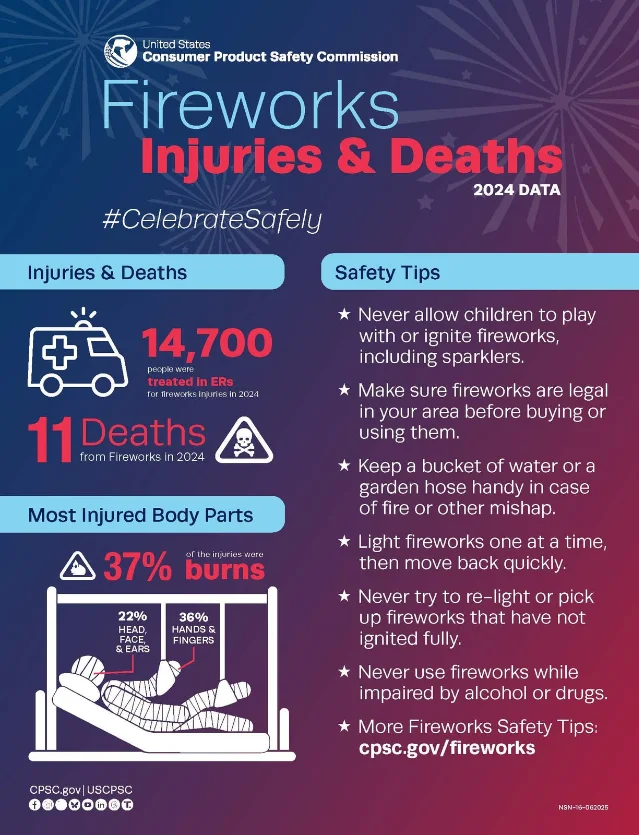
Summer fireworks are sold like party decor, but your body does not care that the packaging looks festive. In the latest CPSC annual fireworks safety release, the agency estimated 14,700 fireworks injuries treated in emergency rooms in 2024, plus 11 reported deaths. People ages 15 to 24 made up 24% of reported injuries, right behind adults 25 to 44. 1
That does not mean you need to hide indoors on the Fourth. It means you need to stop treating fireworks like they are just spicy candles.
The injury pattern is not random
The CPSC numbers point to a pretty clear pattern: fireworks mostly wreck hands, faces, and skin. That tracks with how people actually get hurt: holding something too long, leaning over it, trying to re-light a dud, drinking first and thinking later, or assuming a sparkler is harmless because a child can hold it.
| What happened in 2024 | Why it matters before your next party |
|---|---|
| 14,700 estimated ER-treated fireworks injuries and 11 reported deaths | This is not a freak-accident category. It is common enough to plan around. 1 |
| 1,700 estimated ER-treated injuries involved sparklers | Sparklers are not the safe starter version. They are the “tiny torch” version. 1 |
| Hands and fingers were the most commonly injured body parts, at 36% | If you are holding it, bending over it, or picking it back up, you are in the danger zone. 1 |
| Head, face, and ears made up 22% of injured body parts | “I’ll just look closer” is exactly the kind of move that can send you to the ER. 1 |
| Burns were 37% of ER visits | The most likely injury is not cinematic. It is skin damage that can scar, blister, or need urgent care. 1 |
If you want the safest version, do not be the person lighting them
The boring answer is also the honest one: public fireworks displays are safer than backyard experiments because they are handled by trained professionals with distance, permits, and a plan when something misfires. If your city or school has a show, that is the best option.
If your group is still using consumer fireworks, make one person the designated lighter. Not the drunkest person. Not the person who wants to impress everyone. A sober adult who reads the label, keeps people back, and does the same routine every time.
The CPSC’s practical safety rules are simple:
- Use only fireworks that are legal where you are and labeled for consumer use. 2
- Keep a bucket of water or a garden hose nearby before anything is lit. 2
- Light one firework at a time, then move back fast. 2
- Do not use fireworks while impaired by alcohol or drugs. 2
- Do not try to re-light a dud, and do not pick it up to inspect it. 2
- Do not hold fireworks in your hand unless the instructions specifically say that is how the product is meant to be used. 2
The underrated move: set a “no close-up videos” rule. A lot of dumb injuries start with somebody trying to get content from three feet away. Zoom exists. Use it.
Sparklers deserve their own warning
A sparkler looks cute because it is skinny and handheld. The heat is the problem: CPSC says sparklers burn at about 2,000°F, hot enough to melt some metals. 1
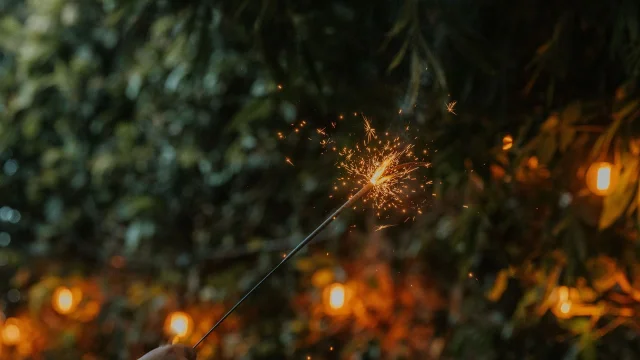
So treat sparklers like a flame, not a photo prop:
- Hold them away from your body and away from other people.
- Do not wave them near hair, loose sleeves, dry grass, patio furniture, or someone’s face.
- Drop the dead sparkler into water, not onto the ground or into a trash bag.
- If kids are around, swap in glow sticks, LED bracelets, confetti, or a night-mode group photo. Nobody’s memory improves because a toddler held a metal stick at 2,000°F.
This is also where peer pressure matters. If one friend is spinning sparklers in a crowd, you do not have to give a lecture. Just say, “Back up, that thing is literally hot enough to melt metal,” and move people out of range.
If somebody gets burned, skip the home remedies
For a small, minor burn, the first move is cool running water. Mayo Clinic says to run cool, not cold, water over a minor burn for about 10 minutes, remove tight items before swelling starts, cover it with a clean loose bandage, and use an over-the-counter pain reliever if needed. 3
Do not put butter, toothpaste, oil, or random “healing” hacks on it. Mayo Clinic warns those can trap heat or make the injury worse, and you should not pop blisters because they help protect against infection. 3
The Red Cross gives a similar first-aid rule: cool the burn under clean, cool running water for 5 to 20 minutes, and do not use ice, because ice can further damage the skin. 4
When it is not a “handle it at home” situation
Firework injuries are weird because the damage can be deeper than it looks at first. If it involves an explosion, the face, the eyes, or a hand, do not waste time debating whether it is “bad enough.” Get real help.
Call emergency services or go to the ER if a burn is larger than 3 inches, looks dry or leathery, has white, brown, black, or charred patches, goes through all layers of skin, wraps around an arm or leg, affects the face, hands, feet, genitals, buttocks, or a major joint, comes with smoke inhalation, or starts swelling very fast. Mayo Clinic also says burns caused by electricity, lightning, or strong chemicals need emergency help, and even a minor burn may need care if it affects the eyes, mouth, hands, or genitals. 3
Red Cross lists explosive burns, burns to the face, mouth, nose, hands, feet, joints, or groin, and burns with blisters or multiple body areas as reasons to seek medical care. 4
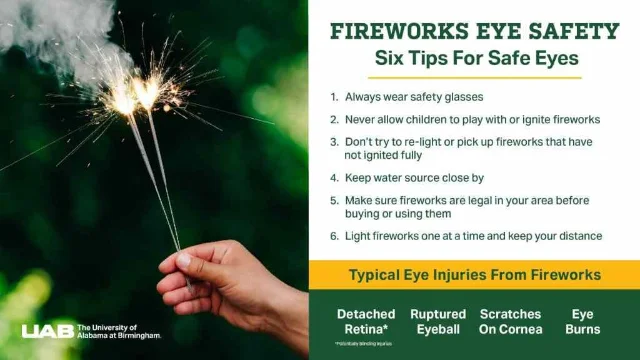
For eyes, use the lowest-drama rule: if a firework, spark, ash, or blast hits an eye, get urgent medical care. UAB Medicine’s fireworks eye-injury guidance says to seek medical attention immediately, and not to rub the eye, rinse it, apply pressure, remove stuck objects, apply ointment, or take blood-thinning pain relievers such as aspirin or ibuprofen. 5
The actually useful pre-party checklist
Before the first lighter comes out, do this:
- Pick the sober lighter.
- Put spectators way back, then add more distance than feels necessary.
- Move cars, pets, dry leaves, paper plates, and trash bags away from the launch area.
- Set out water before anything starts.
- Decide where used fireworks and dead sparklers go.
- Tell everyone the no-re-lighting rule.
- Keep phones zoomed in, not bodies.
- If somebody gets hurt, cool burns with running water and escalate fast for face, eye, hand, large, blistering, explosive, or weird-looking burns.
The goal is not to become the safety cop at every summer hang. The goal is to be the person who makes the night fun and keeps everyone’s hands, eyes, and skin intact.
围绕这条内容继续补充观点或上下文。