
Photoroom's growth playbook: estimated $94M ARR, 150M downloads, and the catalog automation wedge
How Photoroom turned a background remover into an e-commerce visual production system: a simple acquisition wedge, catalog-level retention, and a pricing ladder that expands from subscriptions to API usage and enterprise contracts.

Photoroom looks, at first, like a better background remover. The business is bigger than that. TechCrunch reported that the Paris company raised a $43 million Series B at a $500 million valuation in 2024, while processing about 5 billion images a year and passing 150 million app downloads 1. Sacra estimates Photoroom reached $94.49 million in 2024 ARR, up 89% year over year, though Photoroom itself has not publicly disclosed current ARR 2.
The useful teardown is not "AI photo editing got popular." It is that Photoroom found a repetitive commerce job, made the first edit almost frictionless, then turned the saved workflow into pricing power.
| Signal | What it says about the playbook |
|---|---|
| 150 million downloads and about 5 billion images processed annually | The acquisition surface started broad enough to look consumer, but the repeated job was commerce imagery 3. |
| 1 million-plus businesses | The product is now sold as a listing studio for sellers, brands, marketplaces, and enterprises, not just as an editing app 4. |
| Estimated $94.49 million 2024 ARR | Revenue is a third-party estimate, but it gives a useful scale marker for a category often judged only by download charts 2. |
| Free, Pro, Max, Ultra, Enterprise, plus API plans | Monetization follows image volume and workflow complexity rather than a single seat price 5. |
Acquisition: the wedge was one ugly product photo
Photoroom's first acquisition hook was not a blank prompt box. It was a before-and-after: upload a product shot, remove the background, make the item look ready for a marketplace listing. The company says it first found success with its background remover before expanding into batch editing, AI backgrounds, AI shadows, and generative product-photo tools 3.
That matters because the target user already knows the job. A reseller, Shopify operator, or marketplace seller does not need to learn "AI image generation." They need a clean lead image, a white background, consistent shadows, platform-specific crops, and enough variations to test listings.
The free plan keeps that entry point open, while paid plans add advanced AI tools, batch exports, higher AI-generation limits, and commercial use 6. Photoroom's own comparison page frames the product around marketplace sellers, DTC brands, batch editing, marketplace templates, and business features such as teams and brand kits 7.
The acquisition lesson: choose a job where the first successful output is instantly legible. Photoroom does not have to convince a seller that better photos matter. It only has to show the seller that the next listing can look cleaner in seconds.
Retention: saved presets become switching costs
Photoroom's retention layer is the catalog workflow around the image, not the image edit alone. The homepage pushes Batch Edit, Image API, Marketplace Sync, Enterprise custom models, Brand Kit, Instant Resize, Product Staging, and AI Shadow as parts of the same visual-production system 4.
Once a seller or enterprise team configures those rules, switching tools becomes operationally annoying. The assets that bind the customer are presets, brand colors, shadow rules, product-category formats, API integrations, and review flows.

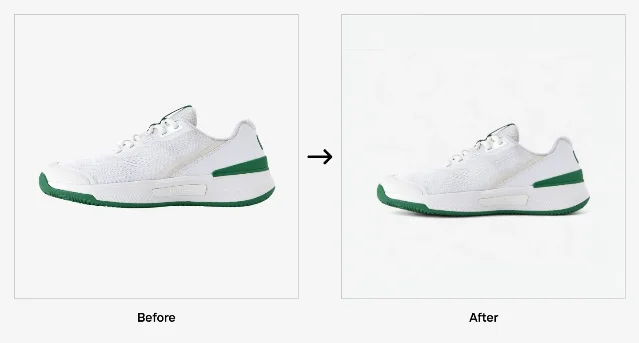
Decathlon is the cleanest example. In a 2026 customer story, Photoroom says Decathlon moved from agencies taking two weeks to process 1,000 images to batch processing 1,000 images in 20 minutes, cut cost per image by 99%, processed 35,000 images in a three-month rollout, and had 99% of product categories pass quality tests 8. The same story says Decathlon used about 100 presets against 150 packshot guidelines, with batches of 250 images and up to four batches running in parallel 8.
Valuence Japan shows the same mechanism at a smaller but still serious scale. Photoroom says Valuence reduced monthly image-processing time from 800 hours to 200 hours, saved about ¥12 million, and processes 24,000 product photos a month for luxury handbags through a Google Drive script integration 9.
The retention pattern is simple: once the software owns the customer's visual rules, the buyer is no longer paying for a prettier editor. They are paying to keep a production line from slowing down.
Monetization: price by volume, then sell the workflow
Photoroom's public pricing ladder maps neatly to product volume. Its pricing page says Pro is for users listing fewer than 30 products per month, Max is for users listing up to 100 products per month, Ultra is for large product volumes, and Enterprise starts at tailored plans for 200,000-plus images per year 5.
For visible consumer and prosumer prices, Photoroom's own 2025 comparison article lists Pro at $12.99 per month or $90 per year, Max at $34.99 per month or $251.88 per year, Ultra from $99 per month or $990 per year, and Enterprise as contact sales 7. The exact price shown to a buyer can vary by country, platform, and billing path, so the important mechanic is the ladder: higher product volume unlocks more AI credits, larger batch export limits, faster processing, and enterprise support.
The API adds a second meter. Photoroom's API pricing page offers 1,000 free sandbox images, shows Basic for remove-background workflows, Plus for Image Editing API and generative capabilities, and says a Basic call is charged at $0.02 per image while a Plus call is charged at $0.10 per image 10. The same page says Enterprise requires an annual commitment and a 200,000-image minimum 10.
That hybrid model is the point. Small sellers pay subscriptions. Power sellers pay for more credits and batch limits. Marketplaces and large brands pay annual contracts, API usage, onboarding, support, and workflow guarantees. In the 2024 funding announcement, Photoroom said teams such as Smartly, Printify, Faire, Bulgari, and Netflix used its API to edit images by the thousands or millions 3.
Transferable takeaways
- Start with a painful, repeated job, not a general AI capability. Photoroom's wedge was product-image cleanup, a task sellers already understood and repeated often.
- Make the first output obvious. A clean product photo is easier to evaluate than a vague productivity claim. That makes activation fast.
- Turn settings into lock-in. Brand kits, presets, shadows, batch rules, API keys, and marketplace formats become the retention system.
- Let pricing follow volume. Photoroom can serve a reseller, a high-volume seller, and Decathlon because its pricing expands from free use to subscriptions, credits, API calls, and annual enterprise commitments.
The gap to watch is current company-disclosed revenue. Until Photoroom publishes newer ARR directly, the strongest verified signals are usage scale, funding, customer outcomes, and the pricing architecture around image volume.
参考来源
- 1Confirmed: Photoroom, the AI image editor, raised $43M at a $500M valuation
- 2Photoroom revenue, valuation & funding
- 3Photoroom Secures $43M in Series B Funding
- 4Photoroom homepage
- 5Compare Pro, Max, Ultra & Enterprise Plans
- 6What are Photoroom's plans?
- 7Photoroom vs Pixelcut
- 8How Decathlon slashed image editing costs by 99%
- 9How Valuence Japan saved 600+ hours and launched faster with Photoroom
- 10Photoroom API pricing
围绕这条内容继续补充观点或上下文。